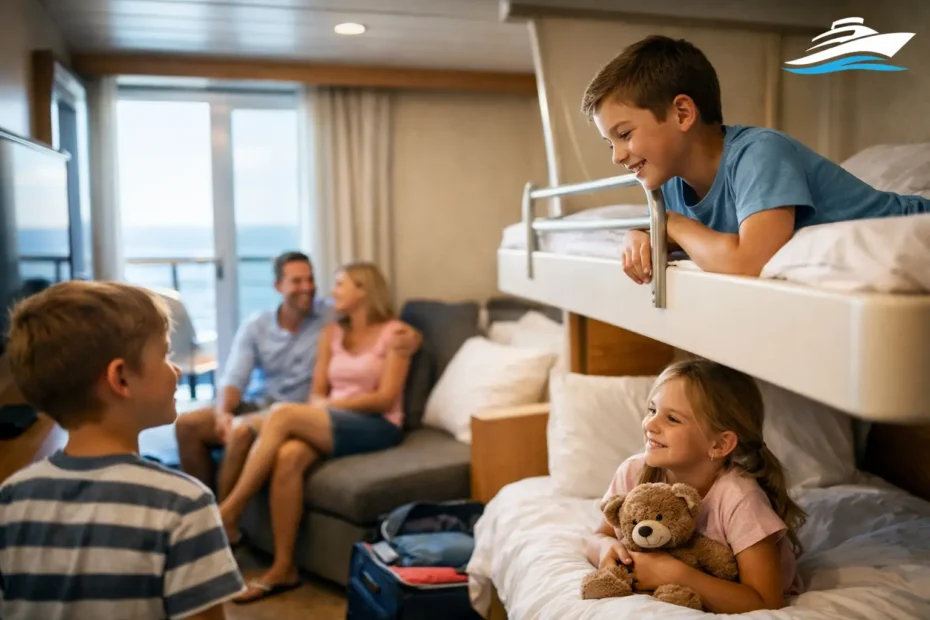
A family cruise can feel easy on paper until you realize four people, four suitcases, wet swimsuits, and different sleep schedules are all supposed to fit in one cabin. That is why the best family cruise cabin layouts matter more than many first-time cruisers expect. The right layout can mean better sleep, fewer bathroom bottlenecks, and far less stress by day two.
Cabin size matters, but layout usually matters more. A slightly smaller room with true separation between sleeping areas can work better than a larger cabin with everyone stacked into the same open space. For families, the question is not just how many a cabin sleeps. It is how that cabin actually lives.
What makes the best family cruise cabin layouts work
The best setups solve three common problems at once – sleeping, storage, and privacy. Parents need a place to sit after the kids go down. Kids need beds that do not take over the entire room all day. Everyone needs enough floor space to move around without stepping over shoes and backpacks.
Good family layouts usually have one of these advantages: a separate bedroom, a curtain divider, bunk-style beds that tuck away, or a split bathroom arrangement. That last one often gets overlooked, but it can be a game changer. On some ships, the shower and sink are in one space while the toilet and another sink are in a second space. That means more than one person can get ready at a time, which is a big win for families trying to make breakfast or shore excursions.
The trade-off is price. The more privacy and separation you want, the more the fare usually climbs. Still, not every family needs a suite. In many cases, the smartest value is a standard category cabin with a layout that works harder.
Best family cruise cabin layouts by cabin type
Standard balcony cabins with pullman beds
For many families of four, this is the most common option. You will usually have a queen bed that can split into twins, plus upper pullman bunks or a sofa bed for the kids. During the day, those extra beds fold away, which gives you back some floor space.
This layout works best for families with younger children who go to bed early and do not need much personal space. It is affordable compared with suites and often gives you the balcony parents want. The downside is obvious by nighttime – once the extra beds are down, the cabin can feel tight fast.
If your kids are light sleepers or your family keeps different schedules, this setup can feel cramped. But for a port-heavy itinerary where the cabin is mostly a place to shower and sleep, it can be a strong value.
Family inside cabins
Some ships offer specially designed family inside cabins that sleep more people than a standard interior room. These can be a practical choice if keeping the budget under control matters more than having a view.
The benefit is simple: more sleeping capacity for less money. The drawback is just as simple: no natural light and, on many ships, limited separation within the room. If your family is active and plans to spend most of the day out on deck or ashore, that may not matter much. If anyone in your group needs daylight or downtime in the room, an inside cabin can start to feel small quickly.
Family oceanview cabins
This is often the sweet spot for families who want extra room without suite pricing. Family oceanview cabins on some cruise lines are larger than standard cabins and may include better sleeping configurations, extra storage, or a more usable sitting area.
A window does more than provide a view. It makes the room feel less closed in, which matters when several people are sharing the same space. These cabins are especially good for families who want comfort but do not feel strongly about having a balcony.
Mini-suites and junior suites
These categories can be worth the upgrade if you want a larger sitting area and a little more breathing room. Depending on the ship, you may get a curtain divider between the bed and sofa bed area, a larger bathroom, or simply enough square footage that the room does not feel crowded.
This is where details matter. Not every junior suite is truly family-friendly. Some are just larger open rooms with prettier finishes. Others have a layout that genuinely helps a family function better. Before booking, it is worth checking whether the extra space is usable space or just decorative square footage.
True family suites with separate bedrooms
If your budget allows, this is one of the best family cruise cabin layouts available. A separate bedroom for parents and a living area with a sofa bed or bunks for kids changes the entire experience. You can put children to bed and still talk, read, or watch TV without sitting in the dark.
These cabins are especially valuable for multi-generational groups, families with older kids, or anyone taking a longer cruise. The main issue is cost. Suites can price far above standard categories, and the value depends on how much time your family will actually spend in the cabin.
Connecting cabins
For many families, connecting cabins are the smartest answer. Instead of forcing everyone into one room, you book two cabins with an interior door between them. That often gives you two bathrooms, more storage, and significantly more privacy.
For a family of five or six, connecting cabins can be a better value than one suite. They also work well for parents traveling with teens, grandparents, or kids with very different bedtimes. The caution here is availability. Connecting cabins are limited and tend to go early, especially on school-break sailings.
Best family cruise cabin layouts for different ages
A good layout for a family with a toddler is not always the best one for a family with teens. That is where many cruise bookings go sideways.
For families with young children, cabins with pullman beds or sofa beds often work well because younger kids usually do not need much separation. Being in one room can even feel easier at bedtime. Look for bathtubs if that matters to your routine, and prioritize storage so strollers, diapers, and extra gear do not take over the room.
For families with grade-school kids, a larger oceanview, mini-suite, or connecting cabin often makes the trip smoother. Kids at this age still share space fairly well, but the extra room helps with downtime and getting ready.
For teens, privacy starts to matter a lot more. Connecting cabins are often the best answer, followed by true suites with separate sleeping spaces. Teens tend to stay up later, sleep later, and spread out their belongings. A layout that feels fine for little kids may feel frustrating with older ones.
Layout features worth paying for
Not every upgrade is worth it, but some are. Split bathrooms can save real time. Separate sleeping zones can save everyone’s mood. A balcony can be wonderful, but if the choice is between a balcony and a better interior layout, many families are happier with the better layout.
Storage is another feature people underestimate. Look for cabins with more closet space, drawers, and room under the bed for luggage. On a family cruise, clutter builds fast. Good storage keeps the cabin usable.
Location matters too. Mid-ship cabins are often better for motion sensitivity. Cabins near kids clubs can be convenient, but cabins too close to elevators or busy public spaces may be noisier. The best layout on paper will not feel great if the cabin is in a loud area.
When one cabin is enough and when it is not
One cabin is usually enough for a family of four with younger kids, especially on shorter sailings. Once you move into longer cruises, older children, or five-plus passengers, the calculation changes. At that point, two cabins may not be a luxury. They may be the more practical option.
This is where experienced planning helps. Cruise lines price cabins differently, and sometimes two connecting rooms cost less than a suite with less flexibility. Sometimes a family oceanview beats a balcony in both space and function. You do not want to assume the highest category is automatically the best fit.
At The Cruise Headquarters, this is exactly the kind of detail that saves families money and headaches. The right cabin is not just about what looks nicest online. It is about how your family will actually use the space once you are onboard.
A few mistakes families make when choosing cabins
The biggest one is booking based on occupancy alone. Just because a cabin sleeps four does not mean four people will be comfortable in it. Another common mistake is overpaying for a balcony when a larger oceanview or connecting setup would serve the family better.
Families also underestimate bedtime logistics. If your child goes to sleep at 8:00 and the whole family is in one open room, what happens next? That question alone can steer you toward a very different layout.
And finally, many cruisers wait too long. The most functional family cabins are limited. Connecting cabins, family oceanviews, and true family suites tend to disappear early, especially on holiday and summer sailings.
The best choice is the cabin that gives your family enough space to rest, reset, and enjoy the trip without feeling boxed in. When the layout fits your real routine, the whole cruise feels easier from the first night forward.
Pingback: Royal Caribbean Review: Find Your Best Ship, Cabin, and Itinerary Fit
Pingback: Cruise Formal Night Packing: One Outfit That Works Everywhere
Pingback: MSC vs Norwegian for Families: Which Cruise Line Fits Your Budget